
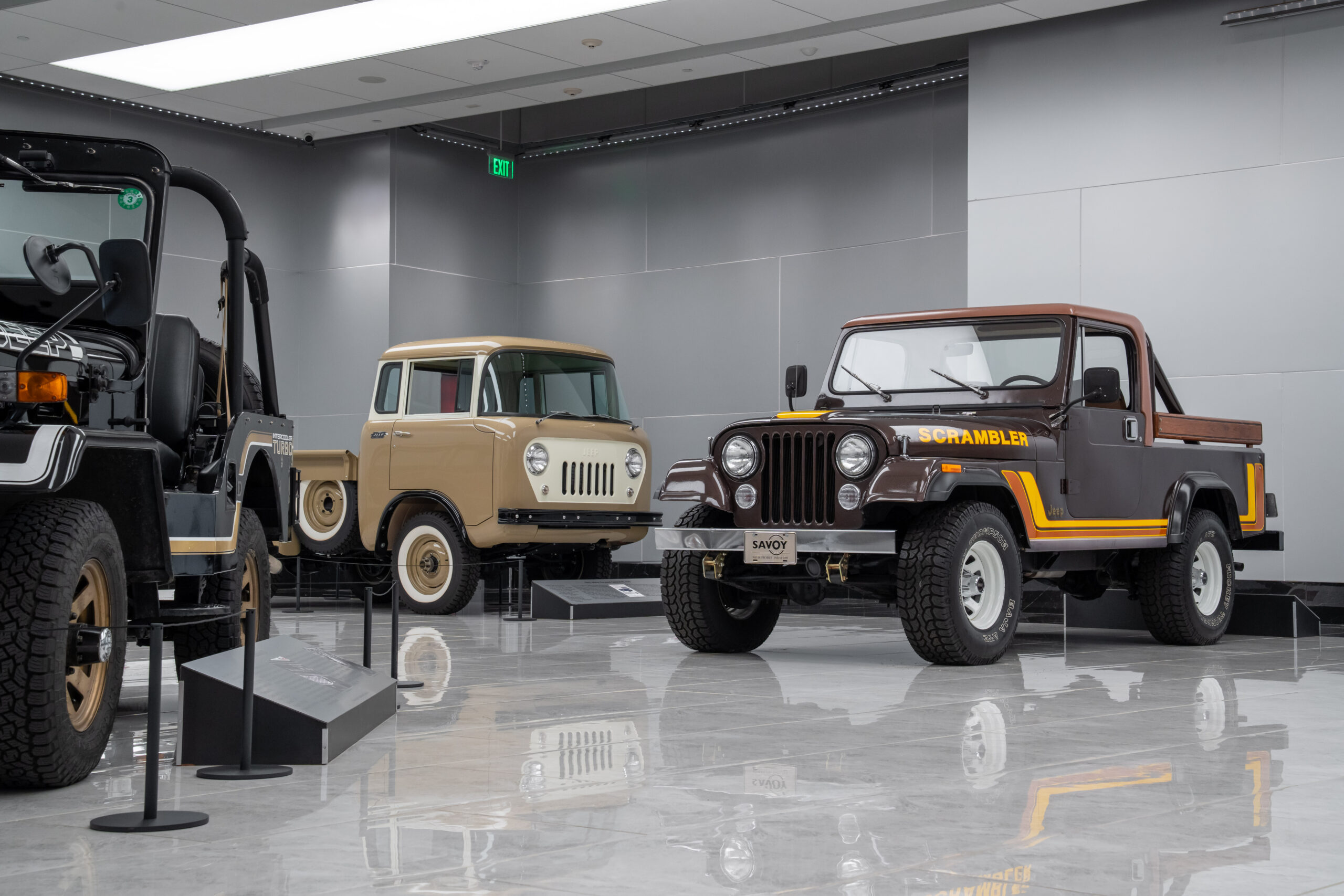
The Jeep is as iconic an automobile if there ever was one. Although its roots are in the military, today’s Jeep is civilian through and through with an enthusiastic fan base. It’s no longer your G.I. great-granddaddy’s wartime ride.
Although the Jeep’s recognizable size and shape remain much the same, the brand has undergone quite a number of style modifications over its history. Savoy Automobile Museum is giving a peak into those changes with a new exhibit, Wartime Hero to Weekend Warrior, on display now through November, 8, 2026.
The Jeep’s story begins in 1940 with war already engulfing Europe. America could feel itself being sucked into the maelstrom and the U.S. Army was preparing.
Among the gaps in wartime readiness was the need for a four-wheel drive reconnaissance vehicle that could move quickly within a battle space. The Army knew what it wanted: a vehicle weighing 1,300 pounds or less with a top speed of 50 MPH, and with capacity for 600 pounds of payload, at least three soldiers, and a 30-caliber machine gun.
The army put out calls for designs, giving manufacturers just 49 days to produce a prototype. Three companies answered the call: the American Bantam Car Company, Willys-Overland, and the Ford Motor Company. Bantam got to the finish line first with its Bantam Reconnaissance Car (BRC), followed by the Willys-Overland Quad, and Ford’s Pygmy.
The Army blended the best of the three designs with much of the end product resembling the Willys-Overland Quad. They naturally won the bulk of the contract to produce the updated Willys MB, but Ford also got a cut of the production with their GPW. The two companies produced around 640,000 vehicles between 1941 and 1945.
Ironically, Jeep wasn’t the official name, but a military nickname that originated in World War I. Soldiers then called untested human recruits and vehicles “jeeps,” and World War II G.I.s soon began calling the odd little autos rolling off of supply ships by the same name. Although the Jeep proved itself handily in both Europe and Asia, its “rookie” moniker stuck.
With the war’s end in sight, Willys-Overland saw a commercial potential for the Jeep. In 1945, they began producing the CJ (Civilian Jeep) and its now recognizable seven-slot grille, followed later by the Jeep Wagon and Truck. They also made the “Jeep” name official when they obtained its trademark in 1950.
Willys-Overland first marketed the CJ to small businesses, farmers, and ranchers as a “workhorse,” and some early models even had attachments like power take off (PTO) useful to those latter professions. Its commercial appeal would later extend to other endeavors like mail delivery or powering Zamboni® ice machines. Eventually, the Jeep found a deep niche in the off-road and passenger vehicle markets.
Who made the Jeep also changed with time. Kaiser Motors acquired the line when they bought out Willys-Overland in 1953. American Motors (AMC) was the next to own it, introducing the Jeep Cherokee (XJ) in 1984 and the Jeep Grand Cherokee in 1992.
Several acquisitions later and Stellantis (a merger of Fiat, Chrysler, and Peugeot) now owns the Jeep line—and a following more subculture than brand preference. “Jeepers” now have their own traditions like “Jeep Ducking,” the practice of leaving small rubber ducks on strangers’ jeeps. You’ll also find Jeep owners congregating in organized events like the annual Easter Jeep Safari in Moab, Utah.
All told, more than 20 million Jeeps have made their way into the world since 1940. And although the brand has had its ups and downs, it remains a popular slice of American culture.
Savoy Automobile Museum’s Wartime Hero to Weekend Warrior exhibit has seven Jeep models on display from various eras of its production. If you’re a fan of the brand, you’ll be able to see a wartime 1942 Ford GPW, as well as a civilian 1950 Willys-Overland VJ-3 Jeepster. Other models, like a 1981 Scrambler and a 1987 Grand Wagoneer, reflect many of the changes in design and features that still reverberate in today’s models.
Wartime Hero to Weekend Warrior will be on display July 14-November 8, 2026, at Savoy Automobile Museum in Cartersville, Georgia, just off I-75 between Chattanooga and Atlanta. To plan your visit or purchase admission tickets, visit us at https://savoymuseum.org/.